Sunday, February 15, 2009

Solid State Photomultiplier

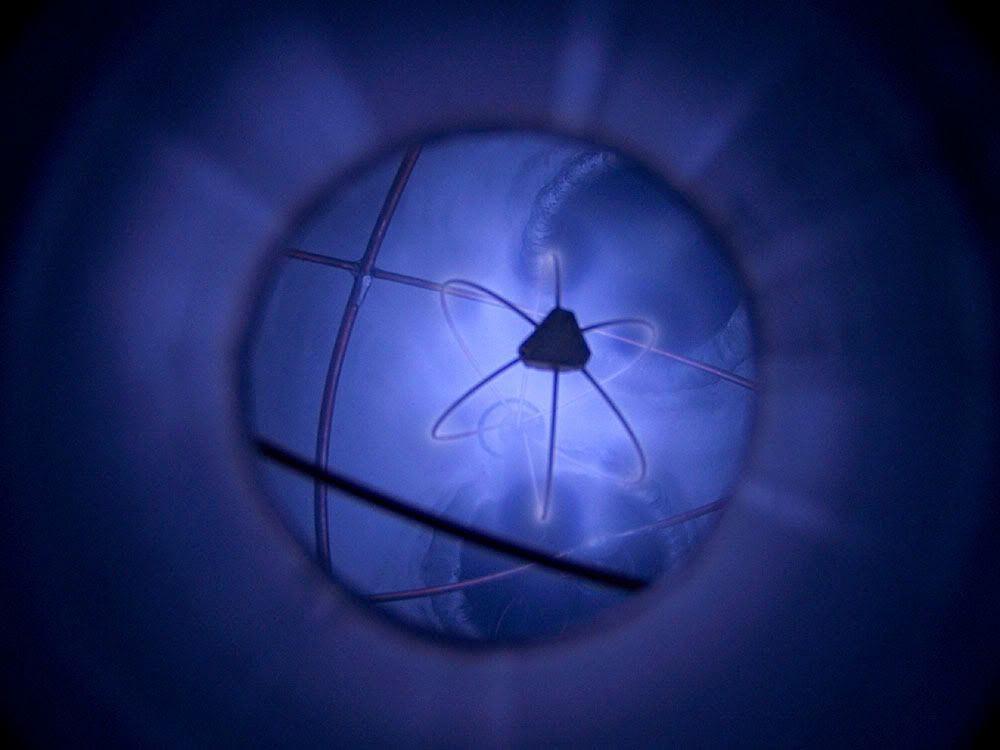
A company called Amplification Technologies has invented something called a solid state photomultiplier.
Amplification Technology Inc. has developed a new solid-state semiconductor technology solution for low-level signal detection: multichannel Discrete Amplification (DA).

The patented DA platform technology, invented by company scientists, is a breakthrough in the design of photon detectors, providing these detectors with unique competitive advantages. Use of DA in semiconductor detectors increases their sensitivity markedly, and enables the creation of new detector systems for various applications including medical diagnostics, security systems, telecommunications, environmental monitoring and drug discovery.
They really don't give many details of their technology but if it works as stated it could be a real boon to designers of particle detectors. The output of the device is low impedance (50 ohm) so that it should be much less susceptible to electric field noise such as is found in installations that depend on high voltage for their operation.

Tube photomultipliers, because they are high impedance devices, are notorious for their susceptibility to electric field noise. Like a photomultiplier this device is inherently high speed. The company recommends a standard microwave amplifier rated at 4 GHz for use with the device. Such solid state amplifiers are available for a dollar or two in small quantities. Pulse lengths of under a nanosecond are resolvable. In that respect their performance is similar to a photomultiplier and like a photomultiplier it can detect single photons with about the same efficiency as a photomultiplier. The gain of the device is around 1E5. Similar to that of a photomultiplier.

The question of course is: are all these improvements available at a reasonable price?

Saturday, February 7, 2009

Engineering Plan

I was having a discussion with a correspondent about how to organize a Polywell Fusion engineering program. I though I had discussed that here but it turns out that I made my remarks at NASA Spaceflight. So I would like to revise and extend those remarks.

==

Since I'm thinking along Manhattan Project lines I think we need a name for our little venture. I propose the "Rock River Engineering District". I don't know, it just came to me. So how should the Rock River Engineering District be organized?

We start with a project management (PM) team with representatives from each of the labs and the main functional groups. Project management is above all responsible for results. Budgets and schedules too. The job of PM is to make sure all the horses are pulling in the same direction.

Now what about project teams? Start with a power reactor group. A thermal group. An electrical group (power and control). A test reactor group. And a support group consisting of mathematicians, metallurgists, electronic design, etc. and administrative support - purchasing, contracts, etc.

The reactor group alone is going to have to have subgroups: electron guns, fuel injection, vacuum group, magnetics group, collection grid group, plasma physics. Possibly others - all working with the thermal group. Plus you want to have some mathematicians on staff for helping the engineers with the hard stuff. Reduce the engineering to algebra/trig or computer programs with graphical and table outputs.

Then you have to have some one who can ride heard on this collection of prima donnas. If they aren't prima donnas I don't want them on the program. Think Manhattan Project. Or Rickover re: nuke subs. We want very smart experienced people with an excess of confidence. With a pessimist riding herd.

I think it took the Naval reactor group from 1948 to 1953 to get delivery of the sub reactor prototype. With 6 years prior experience in low power and low power density reactors.

Wednesday, February 4, 2009

So I'm Discussing With Art Carlson

So I'm discussing with Art Carlson whether it is worth it to look deeper into the Polywell Fusion Reactor design and do some experiments with superconducting coils and continuous operation of a test reactor. Said experiments to cost about $10 million. Well Art is sure that the explanation that Physicist Robert Bussard gave for how the device works can't possibly be true and it is all just a bunch of believers. Cultists if you will. He did not hold back when expressing his views.
StevePoling wrote:
Can anyone articulate an experiment that would falsify either proposition? I mean something cheaper than building a fully-operational Wiffleball-N?
I spent some more time pondering this. I was thinking in the direction of leaving out the cusp itself and just investigating a pencil of plasma propagating along a field through hoops of various potential. Then I realized this is pointless because whiffle-ball theory is not falsifiable.

I mean, suppose I set up an experiment involving cusp physics and electric fields and I showed that it all worked as I expected. What would the polywell proselytes say? That the real polywell has (unspecified) non-Maxwellian effects that my setup didn't take into account. That is basically the last answer I got from Rick Nebel. Of course I can't refute that because nobody has ever said what those effects might be in detail. Maybe if I worked real hard for a year or so (Are there any volunteers to pay my salary?), I could prove a fairly general theorem that would rule out a large class of options. (My shining example for this type of calculation is Todd Rider.)

Basically, there is no whiffle ball theory, only some handwaving with manifest inconsistencies. On the experimental side, there is no published, robust evidence that anything unusual is happening at all. What are we doing here?
But it is falsifiable at least ultimately in an engineering way. Either you get more power out than you put in or you don't.

For $10 million we build the Super Conducting coil job and that should tell us if a power producer is possible. It should also be possible to measure the wiffle-ball. Lasers. Microwaves. Field probes. Whatever.

Or we might go with a lower cost liquid nitrogen cooled copper magnet coil version. It would have a much lower magnetic field than a superconducting coil. But you can build it faster. Vary the current through the magnet coils and see how the losses scale.

I must say though that I'm starting to feel like a tokamak guy: "there are problems that can only be worked out at the next larger level". It must be a plasma physics disease.

Tuesday, February 3, 2009

Interesting Power Supply Company

Commenter windmill at Talk Polywell has brought to my attention an interesting power supply company Diversified Technologies Inc. Here are a couple of short (under 10 pages) papers that explain the technology.

Solid State High Voltage DC Power Distribution & Control [pdf]

Here is the key point from the above [pdf].
The largest cost components in this design are the semiconductors (IGBTs). Because of their widespread use in locomotive engines, subway cars, elevators, and a wide range of electrical motor drive and power supply systems, these devices are evolving at a rapid pace, especially in comparison with vacuum switch tubes. In the last decade, we have seen the switching speed and power handling capability of IGBTs increase by an order of magnitude (200 kVA to 4 MVA), at essentially constant prices. This puts high power electronics, for the first time, on a favorable, long term cost reduction path. This is the equivalent of the computer industry’s Moore’s Law of continually higher performance per unit cost, but applied to power systems.

Today, a 100 kV, 2MW buck regulator, with a series switch, can be built for approximately $500k USD. This cost will decline due to increased semiconductor performance and decreased manufacturing costs. In contrast, estimates for the equivalent conventional approach are $2- 3M USD, and show no trend towards cost reduction.
Quite so. IGBTs with a voltage rating of 6,500 Volts and a 600 Amp current rating are now off the shelf.

A Solid-State Switch for 13.8kV Power Distribution [pdf]

The company claims to be able to make power conversion equipment that costs in the range of 10¢ a watt in production quantities. That is a very good number. Diversified claims specifications for their supply technology that are very not too bad. An adjustable 100 KV DC supply can deliver 1% regulation and .1% ripple. That is just the ticket for Polywell Fusion experiments using D-D. For pB11 at the resonance peak I'd like to see tighter regulation. Say .1% regulation and .01% ripple. I have some ideas.

Friday, January 30, 2009

Easy Low Cost No Radiation Fusion

I thought it was about time to post this here. Originally posted at: Easy Low Cost No Radiation Fusion. Let me note that Low Radiation is more apt than no radiation. The main reaction between Hydrogen and Boron 11 produces only alpha particles which can be stopped with a layer or two of aluminum foil. However there are side reactions which will produce about one millionth the neutron flux of an operating fission reactor. If construction materials are chosen carefully there should be no long lived radioisotopes.

Why hasn't Polywell Fusion been funded by the Obama administration?

==

Justin at Classical Values has put up a posts about fusion energy machines way different from the magnetic confinement and heating machines the government is building.

You can read the post here. Eric of Classical values has another post on the subject.

For more details on the physics visit EMC2 Fusion. You can also make a donation there to help the work go forward.

An interesting question is: when was the first steady state (operation times of at least 10s of seconds) electrically operated nuclear fusion machine which produces at least 10s of millions of fusions a second built? The astounding answer? 1959. So far 18 experimenters have produced similar machines including this young experimenter.

The next question is: why have advances been so slow in since then? The answer (and a lot more) is given in this video by Robert Bussard. (note: dial up is going to be incredibally slow as the video is around 1 hour and forty minutes - aproximately 170 mega-bytes) The video tends to the technical and I will have to study it a few times to get all the details. However a fair understanding of high school physics should suffice. Even if you don't understand the physics the general concepts are easy to understand and Dr. Bussard's enthusiasm is infectious.

In any case the idea is to build a fusion device that produces no long lived nuclear radiation and that works with the forces of nature instead of against them. The voltage required to make these devices work is on the order of 10 to 20 thousand volts or less. About the same voltage as you would find in a tube type monitor or TV set. Nothing very exotic. For a full scale power producer it is predicted that you would need about 2 million volts. Well within the range of current technology for small scale devices. Currently the highest voltage used in electrical transmission is 1.15 million volts. Scaling that up to two million volts for production devices should not be too difficult.

Near the end of the lecture (about 1 hour in)Dr.Bussard gets to the heart of the matter by listing the advantages of this type of power plant.

Stop Greenhouse Effect

Eliminate Acid Rain Sources

Decrease Thermal Pollution Sources

Stop Nuclear Waste Production

Destroy Nuclear Waste Inventory

End Water Shortages Forever

Cheap Fuel Free Electric Power

Clean Low Cost System

Fresh Water From The Sea

Practical Space Flight

Global Economic Stability

Cheap, Clean Thermal/Electric Power Readily Available

Fixed Energy Prices Stabilize Economy

Low Value Cane In Third World Countries Becomes High Value Export Product

Third World Nations Can Become Economically Viable

Profitable Industrialization Possible

Destroys World Market For Gasoline

Eliminates Effect Of Oil Cartels

Oil States Suffer Drastic Income Losses
(audience: laughter - ed.)

Desalinization Plants Allow Irrigation Of Arid Lands

Cheap Water Allows Effective Agriculture

Low Cost Power Stabilizes Industrial Nations

Oil Wars Vanish

Mid-East Stabilized by Economics

Third World Becomes Fiscially Responsible
(comment: not likely, more energy does not fix bad government - ed.)

End Use Market Price Ca. $5,000 B In Year 2000 $
(all products the machine can replace - ed.)

Sell/Lease Systems To Supply Energy Plants/Production

Royalty/Lease Fees at 2% of Market Price Equivalent To Ca. 2m/kWhr Surcharge Yields Net Income (Profit) at Ca. $100 B/Year
(which means an estimated electrical cost of 100 mills/kWhr - ed.)


Dr. Bussard says he needs $200 million dollars and five years to build two full scale demo plants. The first year of his five year plan will replicate with improvements his last experiments to get data on the process that can be verified by a review comittee. The First year will cost $2 million dollars.

He says that a computer to do proper simulations on the system would cost $8 million dollars.

Wiki on Dr. Bussard:
In the early 1970s Dr. Bussard became Assistant Director under Director Robert Hirsch at the Controlled Thermonuclear Reaction Division of what was then known as the Atomic Energy Commission. They founded the mainline fusion program for the United States: the Tokamak.
George Miley at the University of Illinois is doing some work in the field. As is Gerald L. Kulcinski at the University of Wisconsin. Here is the U. Wisconsin IEC Fusion page.

A review of the lecture.

Dr. Bussard Talks


An executive summary of Dr. Bussard's Google talk.

The Bussard Reactor for space propulsion.

A number of links to Dr. Bussard's work. Scroll down.

More good links including links to the Farnsworth patents.

Update: 15 Dec'06 0431z

Mark Duncan in the comments left a link that refers to the Bussard paper given in Valencia, Spain [pdf].

A transcription of the Google presentation [pdf] with illustrations.

Mark has more at Fusion.

Here is a follow up article on the engineering: Reactor Scaling

Hendrik J. Monkhorst did some interesting work on a linear (as opposed to the Bussard spherical design) reactor. Here are a couple of articles one from Science 278 and another one from The University of Florida. Another Monkhorst paper: Science 281. Here is the patent for the Monkhorst/Rostoker design.

Wiki has a nice discussion of the reactions and some techinical details of the various Nuclear Fusion schemes including Dr. Bussard's Boron 11 - Hydrogen reaction.

Update: 11 May 007 0202z

Dr Bussards contract with the Navy has been extended for a year without funding.

Please write your Government and ask them to fund the contract:

House of Representatives
The Senate
The President

and sign this on line petition and send it to your friends to get Dr. Bussard's work funded.

Update: 30 Aug 007 0032z

The US Navy has funded the next phase of Polywell research. This is no reason to let up. The Navy plans a five year program to construct a 100 MW test reactor. With more money they could speed up development. With enough cash a three year time line ought not be difficult. Two years is an outside possibility if we really pour it on.

Update: 20 Sept 007 1012z

If you want to get more into the design details of the Polywell Reactor you might want to try:

IEC Fusion Newsgroup

Details on the design of an open source fusion test reactor.

IEC Fusion Technology blog

Update: 29 Dec 2007 2112z

I should have posted this here months ago. It is a link rich overview of Dr. B's life. He died in early October 2007. The work goes on with Dr. Nebel and Dr. Park of Los Alamos National Laboratories leading the effort:

Dr. Bussard has died.

==
Some books on fusion:

Principles of Fusion Energy: An Introduction to Fusion Energy for Students of Science and Engineering

New Developments in Nuclear Fusion Research

Plasma Physics and Fusion Energy

Introduction to Plasma Physics and Controlled Fusion

==

Here is a report on what is going on at the lab.

Bussard Fusion Update

Update: 19 June 008 0739z

Here are some recent additions you might find useful.

Starting A Fusion Program In Your Home Town

The World's Simplest Fusion Reactor Revisited

Fusion Report 13 June 008

Rick Nebel Updates The Latest News (Dec 2008)

Polywell Fusion - Keeping It Alive

Another short term contract [pdf] for wiffle ball fusion is out for bid by the US Navy. Here is the interesting part.
3.1.1 Contractor shall review the results from Contracts N00014-93-C-0224, N00014-96-C-0039, contract N68936-03-C-0031, and any other publically available current documentation regarding the technical research and development in the field of energy production using a fusion reaction.

3.1.1.2. The review shall primarily investigate the effects of parallel electron heat loss to the coil joints with respect
to plasma stability and electron confinement time.

3.2 TESTS

3.2.1 The contractor will modify/upgrade the existing wiffleball #7 (WB-7) device by installing compact, high temperature coil joints to investigate the electron parallel heat loss. This modified device shall hereafter be identified as Wiffleball #7.1 (WB-7.1).

3.2.2 The Contractor shall test the WB-7.1 to measure the plasma beta (ratio of plasma pressure to the applied magnetic field pressure) and to monitor the wiffleball formation process. The contractor will deploy multiple magnetic field probes inside the device to generate time varying magnetic field mapping to investigate the wiffleball formation.

3.3. The contractor shall take the results of the review specified in 3.1 and tests specified in 3.2 and provide a report detailing workable instrumentation set-ups to resolve the plasma production and physics questions raised in the review and tests for a final report for contracts.
This doesn't look like it amounts to any more than a few weeks of work. I'm going to look into the contracts mentioned and see if I can figure out the intention here.

Update:

Contracts
N00014-93-C-0224 Jan 1995
N00014-96-C-0039 Jan 1996
N68936-03-C-0031 March 2003

H/T KitemanSA at Talk Polywell

Why hasn't Polywell Fusion been funded by the Obama administration? IEC Fusion Technology blog.

What Next For Polywell Fusion?

Dr. Bussard thought that a full scale net energy Polywell Fusion program could be done for $200 million. What could be done to advance the knowledge base that wouldn't require that kind of commitment?

I have been giving some thought to what the next step in the Polywell Fusion experiments might be. Here is what I have so far:

I think a continuous operation experiment (LN2 cooled Cu magnet coils described at WB-7x Design) could reach .45 T for about $20 million. Most of that going into power supplies. That is a rough estimate: +/- 5 million is probably 1 sigma.

If I was begging that is one place to start.

Or maybe forget the big power supplies and go for a pulsed small superconducting model. If a lot of neutrons (1E12/sq cm Second) were not generated (or only generated in pulses) MgB would be a good candidate for the coil material if the coils were totally custom.

Heck it might be good just to buy an MRI machine for the coils. An MRI can be had for about $1 million. If you can get just the coils they might only be $200K. A WB machine built like that could be done for probably $5 to $7 million. If it shows good pulsed results pony up for the power supplies. And start thinking about a 100 MW machine.

Why hasn't Polywell Fusion been funded by the Obama administration?

Thursday, January 29, 2009

Polywell Fusion

It seems to me that funding for the Polywell Fusion Project being run by EMC2 Fusion has stalled.

So I want to do something about that. When ever you post a comment on a blog use this tagline:

Why hasn't Polywell Fusion been funded?


If the blog allows embeded urls you can post this:

Why hasn't Polywell Fusion been funded?
http://iecfusiontech.blogspot.com/

or this:

Why hasn't Polywell Fusion been funded?
<a href="http://iecfusiontech.blogspot.com/">IEC Fusion Technology blog</a>


Contact your Congress Critters and President too.

House of Representatives
The Senate
The President

What is Polywell Fusion?

Easy Low Cost No Radiation Fusion

Rick Nebel Updates The Latest News

Monday, January 12, 2009

Room Temperature Superconductors?

We normally think of carbon as a high resistance material. The first practical electric light bulbs produced by Edison had carbon filaments. However, there is a new kid on the block based on carbon and it is not a superconductor, but it is close. Some recent research in nanotube properties shows very high current carrying capacities.
Relatively early in the research of nanotubes, Thess et al. calculated the resistivity of ropes of metallic SWNTs to be in the order of 1E-4 ohm-cm at 300 K. They did this by measuring the resistivity directly with a four-point technique. One of their values they measured was 0.34E-4 ohm-cm, which they noted would indicate that the ropes were the most highly conductive carbon fibers known, even factoring in their error in measurement. In the same study his measurements of the conductivity, Frank et al. was able to have reach a current density in the tube greater than 1E7 A/sq cm. Later, Phaedon Avouris suggested that stable current densities of nanotubes could be pushed as high as 1E13 A/cm2.
A SWNT is a Single Walled Nano Tubes.

So how does that compare to copper? For household wiring typical current density is 500A/sq cm and ultimate current density is maybe 10X that with the wires near the melting point or beyond. In round numbers 1E4 A/sq cm vs 1E7 A/sq cm for carbon nanotubes. In other words 1,000 times the current density. At a weight per unit volume of about 1/4 that of copper. Copper resistivity at room temperature is about 1.7E-4 ohm-cm. So carbon nanotubes can carry about 5X as much current as an equivalent volume of copper for the same losses.

If we can get this stuff into mass production - which is likely to take twenty or thirty years - we can rewire the grid we have for 5X times as much power as it handles now or the same power with 1/5th the losses. Not room temperature superconductors, but a definite improvement.

Update: A good overall look at Carbon Nanotubes: Carbon nanotubes (CNTs): A small review

H/T IntLibber at Talk Polywell

Sunday, January 11, 2009

A New WB-7 Contract

There is a new contract out for further testing of WB-7.

H/T Aero at Talk Polywell.

Tuesday, December 30, 2008

Mechanical Design: Open FEM

Open FEM is a mechanical design program that can help figure out the stresses and strains caused by the magnets in a Bussard Fusion Reactor. It is based on Scilab, a numerical computation program.

H/T Prometheus Fusion Perfection

Saturday, December 27, 2008

Free Plasma Physics Book


You can read reviews and buy a hard copy of Plasma Physics and Fusion Energyby clicking on the link.

Or you can get a pdf of the book at this detailed review or by going directly to the download link.

The book is very much tokamak oriented so the calculations have limited value for plasmas that are far from thermal equilibrium. However, the ideas presented are of interest to anyone working with plasmas.

Tuesday, December 23, 2008

Steampunk Fusion

Steam Punk Fusion

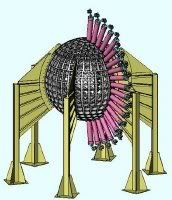
The picture you see above is a steam driven fusion reactor. I know what you are thinking. This is some kind of joke. It is no joke. General Fusion has a design that I think has an outside chance of working.

I was discussing it with some of the boys at Talk Polywell and I'd say it has no fundamental flaws.

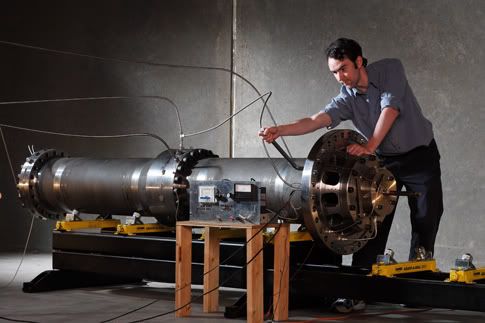
Popular Science also gives some of the details of the machine and its inventors. The drawing at the top of the page shows a schematic of the machine that has 200 pistons. Now to give you some idea of the scale here is a picture of one of the pistons.
Steam Punk Fusion Piston

Huge sucker huh? Now imagine 200 of them all firing away at the rate of once a second. When the piston hits (and yes it will hit) the end of the cylinder it will be going about 250 mph and it will induce a shock wave into a sort of ball of liquid lithium and lead. But first two rings of counter rotating plasma will be shot into the middle of the rotating metal and then all the steam (yeah steam) driven pistons will fire and hit the molten metal with a timing of better than one microsecond.

Can it be done? My rough calculations at the above Talk Polywell link say yes. Not easy, but possible. So would I put money on it? Not me. But I'm an IEC Plasma Fusion type of guy. However, if the idea excites you (a steam driven fusion reactor) I'd say it has as much a chance of working as anything being done now. Definitely worth a shot. And besides how many of your friends can say they are investing in a steam driven fusion reactor? It has got to be worth some bucks just for the conversation starter value alone.

Rick Nebel Updates The Latest News

From Cosmic Log:
First of all, our work has been peer reviewed. An independent panel of experts has looked at these results. I don’t believe that there was anyone on the panel who has less than 40 years experience working with magnetic confinement. It included senior professors and people who have managed the fusion program. We asked them for their honest opinions and that’s exactly what we got. We are proceeding with our program in line with their recommendations.

Secondly, the talk-polywell blog has a large variety of people who post there. There are Phd plasma physicists as well people from the general public. I think that’s a good thing. Science needs to be accessible to people.

Rick Nebel (Sent Saturday, December 20, 2008 12:08 PM)
and
Yes, there are neutrons and the numbers are consistent with the plasmas we are measuring. However, neutrons can be deceptive. A lot of fusion researchers have gotten in trouble in the past by relying on these types of measurements. You need to know where they come from and that's difficult to measure.

R Nebel (Sent Saturday, December 20, 2008 4:31 PM)
Discussed at Talk Polywell. This is one of the places (among several) at the board where the news is being discussed.

Liquid Cooled Grid IEC Reactor

Roger at Talk Polywell provides a link to experiments done with a liquid cooled grid Farnsworth - Hirsh type IEC Fusion device. The device uses a magnetron type ion injector.

You can read about it at RTF Technologies.

I especially recommend the paper describing the construction [pdf].

Wednesday, December 17, 2008

IEC 2008 - Kyoto

I just received a report on the IEC Fusion 2008 conference from Joel Rogers - one of the participants. This is a report of the conference schedule which has links to the abstracts of the papers presented. You can also see the poster for the conference [pdf] which has a very nice picture of a temple on the Uji-Campus of Kyoto University.
Uji is surrounded by beautiful landscapes centering on the Uji River with more than a thousand years of history. It is abundant with historical assets including Byodoin Temple and Ujigami Shrine, both of which are registerd in the UNESCO world heritage list. A lot of historical assets and autumn tints in early December attract many visitors to Uji.

The Byodoin Temple was first a villa owned by Fujiwara Michinaga, the model for the hero Genji in the Tale of Genji. Then in 1052 it was converted into a temple by his son. The central hall in the above photo is popularly known as Hoohdo (Phoenix Hall), an image of which is found on 10-yen coins.
Here is the abstract of the talk [pdf] Dr. Rogers gave.
IEC Polywell[2] is a candidate for commercial power generation. Particle-in-cell simulation was used to follow the time sequence of plasma development starting from neutral deuterium gas in a cubic Polywell. The left figure below shows electrons flowing in and out of the core along 8 cusp lines. The 8 rectangles are 1.0kG coil-magnets separated by 30cm (inside core diameter) and biased to 15kV. Electron guns (5A) are centered on the 4 vacuum tank walls, held at 0V. The center figure shows the ion distribution at Beta ≅ 1 density. Bounded by a 2cm thick shell, the interior ion population is uniform inside the shell. The shell is composed of ions that have slowed prior to reflecting at the edge of the potential well. The right figure shows the ion velocity (U) population. The flat top indicates uniform inside magnitude, |U| = 1.3x10E6m/s (18keV). The fusion rate was computed as n2·<σ(v)·v>·a3/2, where n is the ion density (n=1.1x10E11/cm3), σ is the parameterized DD fusion cross section, v is the ions’ relative velocity, and a is the diameter(20cm) of the ~cubic volume inside which the velocity is uniform. Substituting the simulated n, v, and a, resulted in a fusion rate prediction of 9x10⁷ fusions/s, in fair agreement with Bussard's measured WB-6 neutron rate[2]. The simulation predicts the following features of Polywell: (1) Electrons circulate out and in freely along cusp lines. Very few electrons hit the magnets. (2) Ions are trapped in an electrostatic potential well, which maintains a steady state, spatially uniform, monoenergetic ion population long enough for substantial fusion to occur.
(3) The surface density of trapped electrons corresponds to a Beta value on the order of unity.

Particles reaching the tank wall will generate electricity efficiently while particles hitting the magnets will generate electricity less efficiently. The effective power gain factor (Q) can be estimated as the ratio of fusion power output to the portion of electric power input spent to replace ions hitting the magnet boxes. Simulated Q-factor as a function of device size has predicted the size of a steady state, break-even (Q=1) device which needs to be tested.
The pictures mentioned are included in the pdf.

WB-6 Results Confirmed - Continuous Operation The Next Step

Alan Boyle at Cosmic Log announces the results of the WB-7 Bussard Fusion Reactor (BFR) experiments. And the results? No show stoppers so far.
An EMC2 team headed by Los Alamos researcher Richard Nebel (who's on leave from his federal lab job) picked up the baton from Bussard and tried to duplicate the results. The team has turned in its final report, and it's been double-checked by a peer-review panel, Nebel told me today. Although he couldn't go into the details, he said the verdict was positive.

"There's nothing in there that suggests this will not work," Nebel said. "That's a very different statement from saying that it will work."

By and large, the EMC2 results fit Bussard's theoretical predictions, Nebel said. That could mean Polywell fusion would actually lead to a power-generating reaction. But based on the 10-month, shoestring-budget experiment, the team can't rule out the possibility that a different phenomenon is causing the observed effects.

"If you want to say something absolutely, you have to say there's no other explanation," Nebel said. The review board agreed with that conservative assessment, he said.

The good news, from Nebel's standpoint, is that the WB-7 experiment hasn't ruled out the possibility that Polywell fusion could actually serve as a low-cost, long-term energy solution. "If this thing was absolutely dead in the water, we would have found out," he said.

If Polywell pans out, nuclear fusion could be done more cheaply and more safely than it could ever be done in a tokamak or a laser blaster. The process might be able to produce power without throwing off loads of radioactive byproducts. It might even use helium-3 mined from the moon. "We don't want to oversell this," Nebel said, "but this is pretty interesting stuff, and if it works, it's huge."
The next step in my opinion should be a continuously operating version about the size of WB-7. A device I used to call WB-7x and will probably be called WB-8.

Here are some links to what I think a liquid nitrogen (LN2) cooled magnet coil WB-8 (WB-7x) should look like.

Design Issues including laboratory equipment.
Reactor Vessel Requirements.
LN2 Storage
Magnet Power Supplies
Reactor Building And Reactor Controls
Power Supplies Update #1
Reactor Building Sketches
Electron Guns
Lab Tools
Other Instrumentation - Mass Spectrometer
Research Speed
PID Loops And Leak Valves
Orifice Sizing for leak valves.
Thinking About Control
Ionization Pressure Gauges
Detectors
Turbo Pump Ratings
Gas Valve Design
Data Collection
Vacuum Pumping
Transimpedance Amplifiers
The First Wall Problem
WB-6 Shopping List
LC POPS
Standardizing Fusion Test Reactors
Gauging With Intent
CAN Bus And System Control
Magnetic Field Measurement

For those of you not up to speed on the basics may I suggest:
Easy Low Cost No Radiation Fusion
The World's Simplest Fusion Reactor Revisited

And for those of you who would like to join in on the research at a very modest cost may I suggest Starting A Fusion Program In Your Home Town. There is a lot that can be learned from these very simple devices and some simple instrumentation. There is so much we don't know yet.

H/T Instapundit

Tuesday, December 16, 2008

Amateur Nuclear Fusion - The Book

Amateur Nuclear Fusion
I just came across a book Amateur Nuclear Fusion that is the tale of one guy's efforts to make neutrons in his basement. Here is the blurb from the book:
Here's a look inside an amateur lab that does nuclear fusion. I outline the basic principle of the Farnsworth fusor, and describe my fusor in detail, accompanied with tales of its construction.
The book is not expensive at $12.50 but even better you can get it as a free down load. Both are available at the above link.

H/T Open Source Fusor Consortium

Friday, December 12, 2008

Incoming Energy Secretary On Bussard Fusion


In this Google Tech Talk from about 28 February 2007 you can see Incoming Energy Secretary Steven Chu discussing what he knows about Bussard Fusion about 1 hour 1 minute and 10 seconds into the video. The rest of the talk is about alternative energy, power sources for the future, and how to run a good development program. And what does he know about Bussard Fusion Reactors? Not much. He is looking into it.

I got the heads up from cybrbeast at Talk Polywell.

Monday, November 17, 2008

Tom Ligon To Talk About IEC Fusion Developments

Tom will be at the Philcon Science Fiction convention this coming Saturday, 22 Nov 2008. You can read what Tom has to say about his upcoming talk at Talk Polywell.

Thursday, October 30, 2008

New IEC Fusion Experiment Contract

FedBizOpps.gov has a solicitation for a bid for more experiments by EMC2, Doc Bussard's company now being run (at least on the experimental side) by Rick Nebel.
The Naval Air Warfare Center, Weapons Division, China Lake, CA intends to procure on an other than full and open competition basis a service to provide: 1) Research of Electrostatic "Wiffle Ball" Fusion Device. The contractor is to specifically investigate the required instrumentation to achieve spatially resolved plasma densities and spatially resolved particle energies. This requirement is sole sourced to Energy Matter Conversion Corporation, 1202 Parkway Drive, Suite A, Santa Fe, NM 87501, as the only company in the world investigating and developing this type of device.
What does that mean in terms of progress with the Bussard Fusion Reactor? It means that the experiments delineated in the Fusion Report 29 August 2008 had at least enough success to warrant further work.

Dave Price has some thoughts and more details.

Tuesday, October 21, 2008

Fusion Report 20 October 2008

Alan Boyle brings us up to date on the latest news from the world of fusion. Of course I'm especially interested in what he has to say about Bussard Fusion and their progress to net power. I'll give you the short version:
"We've been pretty busy, but it's the same situation," Nebel told me today. "We're kind of in a holding pattern."

He's been able to keep the five-person team together and "doing a few things" during this holding pattern. There have been some rumblings to the effect that EMC2's results have been encouraging enough to justify pressing forward, but Nebel has declined to make a prediction about the project's future.

Nebel worries about the same kind of budget limbo that the U.S. ITER team is worrying about, even though his budget is an order of magnitude lower. Among the factors on his mind are the change in the White House and the changes in economic circumstances.

"The thing that usually gets hit the hardest is what they call discretionary funding," Nebel said, "and that's what we're looking at here. That'd be the biggest fear everywhere."
So the news is the same as it was at the end of August. No news. Alan Boyle has more on fusion power in general and Bussard Fusion in particular. You can also read my previous Fusion Reports by following the links in: Fusion Report 29 August 2008.

Friday, October 10, 2008

A New Sigma

My friend Tom Ligon has just been inducted into the Sigma Society. Here is what Sigma does:
Many SIGMA members are Ph.D.-level scientists and engineers; all are science fiction writers who have spent careers applying their technical and literary talents in exploring the future of science, technology, society and cultures. SIGMA provides a significant pool of talent for volunteer pro bono consultation with the Federal government and other organizations which need the imagination that only speculative writers can provide.

SIGMA members have each committed to consult with Federal authorities for taskings on vital national issues for several days, for travel and lodging expenses only. For extended effort or research, compensation may be based on individual contracts, as appropriate. Current Federal employees may be available on detailee status.

All SIGMA activities are strictly voluntary, and any member can decline any proposed tasking or meeting for any reason, with no further explanation.
Tom was instrumental in starting the fusor movement (home made experimental fusion reactors) due to the encouragement of Dr. Robert Bussard. He also worked with Dr. Bussard on the Polywell Fusion power reactor (no net power though at the size of current experiments). You can read about that effort at: World's Simplest Fusion Reactor Revisited. There are links on the sidebar to the Fusor Consortium and lots of other good stuff.

You can also read a science fiction story Tom wrote on fusion which had its world premiere here in July of 2007. Getting Tuned Up.

Congrats Tom! And with any kind of luck you can help us to deserve the best future we can get, because if we don't deserve it the getting will be much harder.

Tuesday, September 30, 2008

ITER vs The Stone Axe

Stephen Strauss takes a look at big science and comes away unimpressed. He talks about two exhibits he saw. One for the $15 billion ITER (pronounced EATER - heh) and another about neolithic technology - mat weaving, pottery making, chipping stone axes.
At the recent European Science Open Forum conference in Barcelona, for example, I was strolling through exhibits aimed at — please don't gag — science outreach. The underlying theme of all these displays seemed to me to be: since their schooling actually teaches many ordinary people to be discomforted by — if not to actually fear and loath — science, let's see if we can't do something in these venues to get people to hate science a little bit less.
And why do people hate science so much? Well it is hard to understand and requires a lot of complicated math and difficult concepts. I'm pretty good with that sort of thing. I understand Einstein but the math is beyond me. String Theory? Fuhgeddaboutit. So how about neolithic technology?
Right across from ITER was an exhibit in which a group of paleo-archeologists had set up a display to show the technology of the past in operation. So you had a guy sitting cross-legged, banging away at a rock to make a hand ax. Chip, chip, and chip. You had someone else weaving plants together to make a mat. Weave, weave, and weave. Someone else was taking clay and making a pot. There was no placard asking: Hand axe making, will it always be 40 years away? There were no critics of the effort calling it a huge waste of national resources.

So what does the juxtaposition of the two very different demonstrations of technology tell us about disbelief?

To begin with, the ITER project and all hugely expensive big science efforts — think the International Space Station, think Large Hadron Collider, which recently has received a tonne of press — aren't like making hand axes. I looked at the man diligently chipping away and realized that the price of his failure wasn't very high. So what if it turned out the rock type you made axes from wasn't strong enough to chop wood? You simply went back and made axes from something else until you got an ax that worked.

And you, in this case, would simply be some intrepid carver and not some large part of the Paleolithic science world.

On the other hand, if ITER fails, it is massively unlikely there is going to be another effort to correct its errors. Research on its level is simply too big and expensive and time-consuming. But what if it succeeds — but only kinda? What if its results show that you can produce energy, but that it is 10 time times more expensive than energy from other sources? What if figuring out how to make that equation more favorable will require at least three iterations of ITER?
So how should we be thinking about such projects? A little differently to be sure.
What you put in place with these vastly expensive research efforts is a "can't afford to fail" paradigm. Unlike trying to find the best plant material to weave into a mat, ITER, the Large Hadron Collider, etc., must succeed on first go-round. With ITER, there is no second kind of rock to be chipped away, no other plants to be woven, no different type of clay to be baked into a plate.

And that's what I so disbelieve about it. It's not really experimental science; it's risky, we-can't-fail, all-or-nothing science and I would respond to that paradigm with the wisdom of stone axe makers.

Sometimes your research should be based not on how glorious success might be, but on how little you will have lost if you screw up.
So what should we be doing about fusion? Lots of small "understand the science" and "proof of concept" projects. Say 100 two million dollar efforts. About 10 twenty million dollar efforts based on the successes of the two million dollar jobs. And one or two two hundred million dollar efforts based on the promise of the $20 million efforts. Total cost of around a billion dollars a year when everything is fully ramped up. Nothing that is too big to fail and nothing where testable results are fifteen to thirty years off.

Of course I have my favorites. Here is one that I described in the Fusion Report of 29 August 2008.

Friday, August 29, 2008

Fusion Report 29 August 2008

Alan Boyle has the latest on the EMC2 fusion experiments.
Researchers have finished the first phase of an unorthodox, low-cost nuclear fusion experiment that has generated a megawatt's worth of buzz on the Internet – and they are now waiting for a verdict from their federal funders on whether to proceed to the next phase.

Richard Nebel, leader of the research team at EMC2 Fusion in New Mexico, declined to detail the results of the project, saying that was up to the people paying the bills. But he did said “we have had some success" in the effort to reproduce the promising results reported by the late physicist Robert Bussard.

"It's kind of a mix," he said.
That is a disappointment. However it is not completely negative so maybe further work is warranted.
Nebel said his leave from Los Alamos is due to reach the one-year mark in mid-September, but he doesn't foresee any problem in extending the leave if the second-phase funding comes through. Whether or not the Navy funds the next phase, the past year's effort has been worth it, Nebel said. "We're generally happy with what we've been getting out of it, and we've learned a tremendous amount," he said.

All that learning won't go away. "Regardless of what happens to it, we're going to get this thing well written up and documented," Nebel said.

Getting the experiment's findings down on paper will help the EMC2 team - or future teams of fusion researchers - advance the legacy left behind by Bussard. And that's a fitting tribute to the unconventional physicist as the calendar rolls toward the anniversary of his death.

"Bob Bussard was a truly innovative person, that's abundantly clear," Nebel said. "I hope he will be remembered for that. I think that will be the case."
You will note that yours truly (IEC Fusion Technology blog) got a link from Mr. Boyle. I'm honored. If you haven't seen the material before read the link he gave Tom Ligon. And if you are interested in following the progress to date read Fusion Report 13 June 008 which has links to previous reports.

I can't wait to read the full report.

Tuesday, July 29, 2008

Math For Plasma Simulation

I have added Math For Plasma Simulation [pdf] to the sidebar under Fusion Reference.

H/T drmike

Update 2317z 30 Jan 2010

Link broken. H/T AC via e-mail for the notification and the current correct link.

Friday, July 25, 2008

Magnetic Field Measurement

Electronic Design News [pdf] has an overview of instruments and technologies for measuring magnetic fields.

Thursday, July 17, 2008

A Certain Reality

"As far as the laws of mathematics refer to reality, they are not certain; as far as they are certain, they do not refer to reality."--Albert Einstein

"If we knew what it was we were doing, it would not be called research, would it?" - Albert Einstein

Wednesday, June 25, 2008

Critics

Critics are a very valuable resource if the criticism is based on reason. All designs should be thoroughly reviewed by their harshest reasonable critic. You get better designs that way. Or you kill bad investments before they get too big.

I have to say that right now just from an engineering perspective (assuming the physics works) the challenges of building a 100 MWth BFR are daunting. Not all of them have answers at this time.

Tuesday, June 24, 2008

Students Achieve Fusion

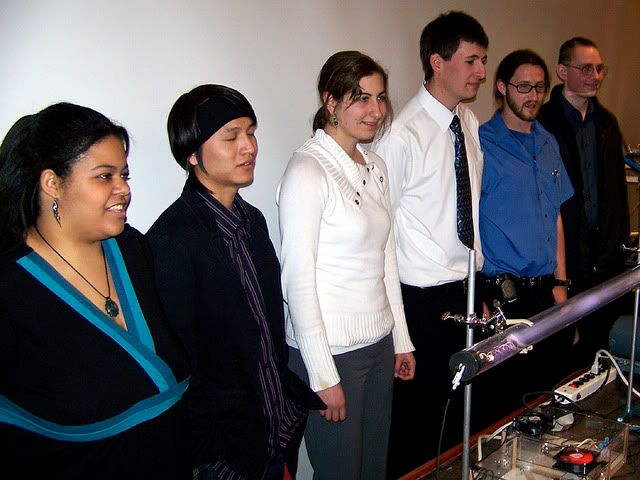
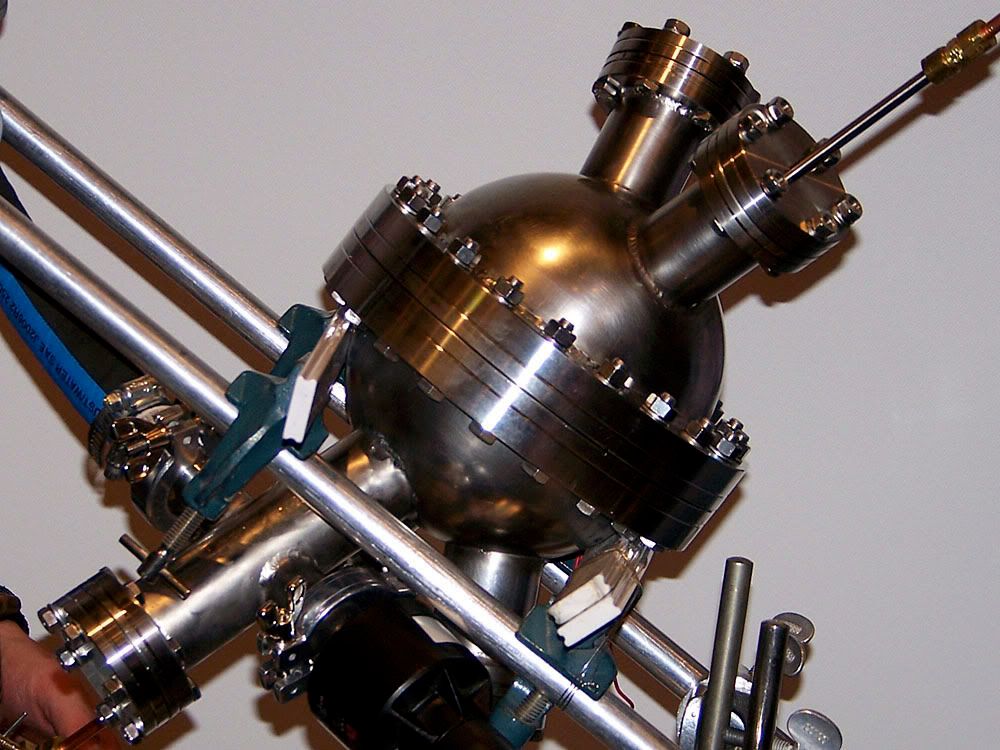
Students at Penninsula College have achieved fusion. I am more than a little proud to say I had a little to do with it. At least in so far as getting them on the right track.

Penninsula College Fusioneers

From left to right: Devon, Ivan, Sarah, Chris, Aaron, and Derek.


The Reactor

The Reactor


Peninsula College Glows

It glows


Which just goes to show that fusion research need not take big labs and big budgets. There is a lot that can be done in small labs to advance the state of the art. So let me encourage the rest of you: Start A Fusion Program In Your Own Home Town. America needs your help. The world needs your help.

Let me add that the genesis of this report was a bit done by ClassicPenny at Talk Polywell

Friday, June 20, 2008

You Have To Be A Little Crazy

Innovate Like Edison is a book about how to use Edison's system of innovation to improve business practices. Control Engineering discusses the book based on a talk given at the recent Society for Manufacturing Engineers Convention in Detroit, MI.
Detroit, MI – Understanding Thomas Edison’s patterns of thinking can help us be more like the guy who has 1,093 U.S. patents to his name, says co-author of the book, “Innovate Like Edison: The Success System of America’s Greatest Inventor.” Sarah Miller Caldicott, also Edison’s great grandniece, helped a packed room of engineers at the SME Annual Meeting gain insights into Edison’s thought patterns, to improve U.S. competitiveness.

Bearing a family resemblance to her great great Aunt Mina Miller – who married Edison in 1886 – and telling stories of growing up with Edison phonographs in her bedroom, Caldicott offered exercises which seemed to win over SME attendees... along with a promise of an autographed book.

Caldicott, also founder of The Power Patterns of Innovation, noted five best practices based on her 3-year study of Edison: a solution-centered mindset; kaleidoscopic thinking; full-spectrum engagement; master-mind collaboration; and super value creation.
All the points are covered in the review, but I'd like to take up this one:
-Cultivate a solution-centered mindset. Do not seize an answer at the beginning of an initiative. A framework of options and pathways can lead to solutions. Look outward and scan the environment. Lean ahead and hunt for a solution. Combine factual information with what-if or if-then thinking. Envision the solution and “emotionalize” the state that will be experienced upon getting there.
Which could be translated into be patiently crazy. Also note that emotion is considered an important part of rational thinking. In fact emotion may be one of the most critical feedback mechanisms. We have a very good pattern recognition system in our brains. If you train your brain with good patterns, after a while you get a "feel" about the right way and the wrong way to do things. Caldicott also goes into the need for thinking before acting. She even calls it contemplation. Be quiet. Sit Still. Shut up. And good preparation for that contemplation time is to get on the www and start looking around. Go deep. Some times the good stuff is on the 30th page of a search.

I always had a standard which I tried to stick to when it came to development: Five days of planning, two days of work. That is both imperative and descriptive. You must recognize that this method is scary for most management. The typical exhortation is: put in all the time you need to, but meet the schedule. My answer was: I'm not putting in any extra time. I will meet your schedule. In two days I will have a plan. How did that work out? Three months were alloted to get the project on track. I did it in five weeks. Without raising a sweat. Of course once you have proven yourself it is easier the next time.

Saturday, June 14, 2008

Some Objections - Some Answers

Art Carlson, who was commenting on an Alan Boyle article about the progress the EMC2 team was making with the Bussard Fusion Reactor tests, had some objections to the whole concept.
It's fun to daydream, isn't it? And it's easy, too, as long as you don't know too much.

There's more reasons than you can shake a stick at that this won't work. For starters, you can forget about aneutronic fusion. It's not just the temperature, Bremstrahlung is almost to certain radiate more energy than you produce by fusion no matter how good your confinement is. Even if you somehow manage to get a decent power balance, for a given plasma pressure and fusion power, a p-B11 reactor would have to be about 1000 times bigger (and more expensive) than a corresponding D-T reactor.

The next thing to worry about is the electrons. The magnetic configuration has not only lines of radial field from the center to the edge, which is bad enough judging from the experience with mirror machines, it also has lines of *zero* field along which the electrons will gush out. The idea of recycling electrons lost through the cusps won't work because they will come out almost parallel to the field but hit the return cusp with a large perpendicular velocity component they picked up going around the bend.

And the ions? The device is conceived to utilize a bi-modal velocity distribution, which will be destroyed very quickly by the two-stream instability. The anisotropy of the velocity distribution is also know to be a big problem, again from experience in the mirror program.

We haven't even started to talk about energy loss to the grids, the consequences of tiny field misalignments, charge-exchange ion losses, energy coupling between electrons and ions, and whether the potential distribution envisioned is even possible at a non-trivial ion density.

Since they managed to sweet talk somebody into giving them money, let them finish and publish their results, but let's not stop looking for ways to save energy and trying to develop other, less sexy but more reliable energy sources.

Art Carlson, Munich, Germany (Sent Friday, June 13, 2008 1:17 PM)
rnebel who is conducting the test and is definitely not day dreaming had a response.
Just a few comments for Mr. Carlson

1. The theory says that you can beat Bremstrahlung, but it's a challenge. The key is to keep the Boron concentration low compared the proton concentration so Z isn’t too bad. You pay for it in power density, but there is an optimum which works. You also gain because the electron energies are low in the high density regions.

2. The size arguments apply for machines where confinement is limited by cross-field diffusion like Tokamaks. They don't apply for electrostatic machines.

3. The Polywell doesn't have any lines of zero field. Take a look at the original papers on the configuration. See :
Bussard R.W., FusionTechnology, Vol. 19, 273, (1991) .
or
Krall N.A., Fusion Technology. Vol. 22, 42 (1992).

Furthermore, one expects adiabatic behavior along the field lines external to the device. Thus, what goes out comes back in. Phase space scattering is small because the density is small external to the device.

4. The machine does not use a bi-modal velocity distribution. We have looked at two-stream in detail, and it is not an issue for this machine. The most definitive treatise on the ions is : L. Chacon, G. H. Miley, D. C. Barnes, D. A. Knoll, Phys. Plasmas 7, 4547 (2000) which concluded partially relaxed ion distributions work just fine. Furthermore, the Polywell doesn’t even require ion convergence to work (unlike most other electrostatic devices). It helps, but it isn’t a requirement.

5. The system doesn’t have grids. It has magnetically insulated coil cases to provide the electrostatic acceleration. That’s what keeps the losses tolerable.

6. The electrostatic potential well is an issue. Maintaining it depends on the detailed particle balance. The “knobs” that affect it are the electron confinement time, the ion confinement time, and the electron injection current. There are methods of controlling all of these knobs.

rnebel (Sent Friday, June 13, 2008 6:17 PM)
One must be wary of a certain kind of dreamer:
All men dream, but not equally. Those who dream by night in the dusty recesses of their minds wake in the day to find that it was vanity: but the dreamers of the day are dangerous men, for they may act their dream with open eyes, to make it possible.
—T. E. Lawrence from "Seven Pillars of Wisdom"

Friday, June 13, 2008

Fusion Report 13 June 008

Alan Boyle has a new report on the goings on in New Mexico at EMC2 Fusion Labs.
Emc2 Fusion's Richard Nebel can't say yet whether his team's garage-shop plasma experiment will lead to cheap, abundant fusion power. But he can say that after months of tweaking, the WB-7 device "runs like a top" - and he's hoping to get definitive answers about a technology that has tantalized grass-roots fusion fans for years.
Dr Nebel has been rather quiet lately in the usual forum he frequents, so this update is very welcome to all us grass-roots fusion fans.
"We're kind of a combination of high tech and Home Depot, because a lot of this stuff we make ourselves," Nebel told me today. "We're operating out of a glorified garage, but it's appropriate for what we're doing."

The Emc2 team has been ramping up its tests over the past few months, with the aim of using WB-7 to verify Bussard's WB-6 results. Today, Nebel said he's confident that the answers will be forthcoming, one way or the other.

"We're fully operational and we're getting data," Nebel said. "The machine runs like a top. You can just sit there and take data all afternoon."
Now compare "We're operating out of a glorified garage... with ITER's 30 % cost over run so far.
an independent panel of experts will be coming to Santa Fe this summer to review the WB-7 experiment, Nebel said.

"We're going to show them the whole thing, warts and all," he said.

Because of the complexity, it will take some interpretation to determine exactly how the experiment is turning out. "The answers are going to be kind of nuanced," Nebel said.

The experts' assessment will feed into the decision on whether to move forward with larger-scale tests. Nebel said he won't discuss the data publicly until his funders have made that decision.
"Warts and all now isn't that refreshing.
Nebel may be low-key about the experiment, but he has high hopes for Bussard's Polywell fusion concept. If it works the way Nebel hopes, the system could open the way for larger-scale, commercially viable fusion reactors and even new types of space propulsion systems.

"We're looking at power generation with this machine," Nebel said. "This machine is so inexpensive going into the 100-megawatt range that there's no compelling reason for not just doing it. We're trying to take bigger steps than you would with a conventional fusion machine."
With my typical engineering sensibilities I still think some intermediate steps would be required. Like a continuously operating experiment. It need not be a very big machine but it will require a big power supply. It might need to draw 4 to 6 MW on start up. In fact it might need that for the whole duration of operation. The machine scales in a funny way. Coil power (for a copper coil demo) goes up as the reactor gets large but the accelerator power goes down.
Over the next decade, billions of dollars are due to be spent on the most conventional approach to nuclear fusion, which is based on a magnetic confinement device known as a tokamak. The $13 billion ITER experimental plasma project is just starting to take shape in France, and there's already talk that bigger budgets and longer timetables will be required.

If the Polywell system's worth is proven, that could provide a cheaper, faster route to the same goal - and that's why there's a groundswell of grass-roots interest in Nebel's progress. What's more, a large-scale Polywell device could use cleaner fusion fuels - for example, lunar helium-3, or hydrogen and boron ions. Nebel eventually hopes to make use of the hydrogen-boron combination, known as pB11 fusion.

"The reason that advanced fuels are so hard for conventional fusion machines is that you have to go to high temperatures," Nebel explained. "High temperatures are difficult on a conventional fusion machine. ... If you look at electrostatics, high temperatures aren't hard. High temperatures are high voltage."

Most researchers would see conventional tokamak machines as the safer route to commercial fusion power. There's a chance that Bussard's Polywell dream will prove illusory, due to scientific or engineering bugaboos yet to be revealed. But even though Nebel can't yet talk about the data, he's proud that he and his colleagues at Emc2 have gotten so far so quickly.

"By God, we built a laboratory and an experiment in nine months," he said, "and we're getting data out of it."
By God I hope it works out.

If you want to know what you can do to help have a look at Starting A Fusion Program In Your Home Town.

H/T Instapundit

Sunday, June 8, 2008

Literate Programming

Literate Programming
Donald Knuth. "Literate Programming (1984)" in Literate Programming. CSLI, 1992, pg. 99.

I believe that the time is ripe for significantly better documentation of programs, and that we can best achieve this by considering programs to be works of literature. Hence, my title: "Literate Programming."

Let us change our traditional attitude to the construction of programs: Instead of imagining that our main task is to instruct a computer what to do, let us concentrate rather on explaining to human beings what we want a computer to do.

The practitioner of literate programming can be regarded as an essayist, whose main concern is with exposition and excellence of style. Such an author, with thesaurus in hand, chooses the names of variables carefully and explains what each variable means. He or she strives for a program that is comprehensible because its concepts have been introduced in an order that is best for human understanding, using a mixture of formal and informal methods that reinforce each other.
I have always programmed like that once I started writing professionally in Forth. Leo Brodie's book Thinking FORTH [free download] was all about using the literate style. The most important thing after Naming the Parts is good factoring.

Friday, June 6, 2008

CAN Bus And System Control

I like CAN (Controller Area Network) Bus for control systems. It has moderate speed (1 Mbs), it is deterministic., it has priority control for multi-master operation, and because of its use in autos it is robust and low cost. In addition it has been on the market for about 10 years so it is well established with lots of vendors to choose from. In addition there are a number of MCUs with built in CAN.

For test reactor operation I see a hierarchy of CAN buses, each devoted to a given function and then all melded into a master bus. Let me start with the sub nets.

1. Vacuum Gauge/Vacuum Pump Control Bus
2. HV Power Supply Internal Buses
3. Instrumentation Buses (Temp Monitoring, Flow Monitoring, Master Clock, Neutron Counter, Electrical Power Measurement and Control, etc.)
4. Auxiliary Control (Electrical Power Measurement and Control, etc.)

And then a master bus to send messages to/from the sub buses.

I haven't decided on an MCU yet. One of the requirements would be that it is FLASH programmable and have a built in CAN bus. I have been thinking about pressure measurement lately so I'd like to lay out what a CAN bus interface would look like.

The pressure transducers I have in mind (MKS 722 and MKS 626A) have a 0 to 10 V output. I haven't picked any other components yet. So we will just look at functions.

1. Pressure (dependent on transducer - from 1000 torr to .1 torr full scale, 17 bits)
2. Board temperature (0 to 100 deg C, nominal 30 deg C 10 bits nominal - 8 actual)
3. Board power bus voltage (20 to 60V, nominal 48VDC, 10 bits nominal - 8 actual)
4. Board power bus current (0 to 255 mA, nominal TBD, 10 bits nominal - 8 actual)
5. Various internal power supplies (TBD, TBD, 10 bits nominal - 8 actual)
6. Isolated CAN supply, Isolated Pressure transducer supply, Isolated MCU supplies.

Lets start with the transducer front end. It should have an op-amp (fully differential).

For the 24 bit converter I like the AD7767 it has an accuracy of 17 bits which matches the one part in 1e5 resolution of the pressure transducer.

The ADA4941-1 is a nice companion amplifier. And the ADR425 looks like a nice reference. Good specs, not too expensive.

That covers the main parts of the analog side. What about the computing side? I have been looking around and I think I like the Fujitsu CAN bus microprocessors the best. Its architecture is a mixture of a FORTH engine and a Z8 register bank.


Fujitsu 16 bit microcontrollers

Fujitsu 32 bit microcontrollers

Fujitsu microcontrollers

I haven't addressed the CAN interface yet. It is pretty simple: a few high speed optocouplers, a bus driver chip, a separate isolated power supply, some protection components and away we go.

Let me add that Fujitsu has 8 bitters that I have yet to take a serious look at. I'll probably remedy that in the next few days.

The Atmel CAN processors would be a good second choice. The reason I like the Fujitsu stuff better is that it has a very good migration path and I'd like to use one software model for as many of the process tasks as possible.


I also like the Infineon TC1166 32 bit processor with CAN. Digikey sells them for about $39 ea. Quantity one. Since programming and hardware design is going to be the big cost for the initial units I'm going to do what Chuck Moore suggests. Get the biggest fastest processor you can afford to start. Then reduce the foot print if volumes warrant.

The Fujitsu part is more open ended and has a very simple CALL structure. However, there are no automatic register saves with calls. Thus every CALL must have at least one PUSH and one POP if you expect nested calls. The Infineon has a more definite programming model with user space registers and system space registers. They each save registers on a CALL (but different sets). The cost is 2 to 5 clocks. Not a big hit (but they could have done better). The Infineon part also seems like it might be harder to learn due to instruction pipeline flushing requirements in some situations that require an instruction to finish before the following instruction(s) are executed. I do like the floating point and some other features of the Infineon, but I will set it aside for now. Well I read on and find that the Fujitsu Part also has a 5 deep pipeline. I guess when you need to flush it you just do a bunch of no-ops.

The Fujitsu also is more deterministic and can do tail end recursion since the pipeline is only one level deep (actually it is five deep also but it can do tail end recursion.). However the divide routines are not as mechanized as they are in the Infineon. Since I hardly ever use them except with user input to precalculate multiply constants that is not such a big hit.

Update 09 Jun 1534z

I have been looking at the Freescale MPC551x MPUs. I like them. Plus Freescale gives away an assembler good enough to get a FORTH up on the chip.

I like the Atmel ATA6660 CAN bus physical interface. There are later and greater chips out with more functionality , however I like to keep the interface simple and electrically isolated. You can do that with three high speed optocouplers and an isolation supply. A 48 V to 5 V job at about 1 W would be good.

FORTH Is Back

The FORTH programming system is one of my favorites. The language is simple, compact, and extremely powerful, and almost dead. It has been kept alive over the years by a few fanatics including myself. Well, it looks like it is coming back in a big way. A lot of big names are now into the game.
By INQUIRER staff: Friday, 07 December 2007, 2:40 PM

PATRIOT SCIENTIFIC, which jointly owns a microprocessor related patent porfolio, said that Taiwanese firm Lite-On has bought a licence, becoming the third firm in a week to do so.

According to the firm, it's the first Taiwanese system company to buy a licence. Daewoo and a US manufacturer said they'd buy a licence earlier this week.

The firm's "Moore Microprocessor Patent Portfolio" that holds IP including seven US patents covering microprocessors, system on chip stuff, and microcontrollers.

This lot have also signed up for licences already. AMD, Intel, Hewlett Packard, Casio, Fujitsu, Sony, Nikon, Seiko Epson, Pentax, Olympus, Kenwood, Agilent, Lexmark, Schneider Electric, NEC Corporation, Funai Electric, Sandisk, Sharp Corporation, Nokia, Bull, Lego, DMP Electronics, Denso Wave, Philips, TEAC, Daewoo Electronics. And now Lite-On.
Now that looks like a rush. Why? Well, a dual stack architecture is pretty well fitted to C. Although C is no near as efficient as FORTH with such an architecture. EE Times Asia has more on the story.
06 Mar 2006

Alliacense announced that Fujitsu Ltd has licensed its intellectual property protected by the Moore Microprocessor Patent (MMP) portfolio. Alliacense is the subsidiary created last year to administer the portfolio on behalf of owners Patriot Scientific Corp. and TPL Group Financial terms of the licensing arrangement were not disclosed.

Fujitsu becomes the third system manufacturer to publicly disclose licensing of the MMP portfolio, following Hewlett-Packard (HP) in January and Casio Computer Co. Ltd last week. In announcing the Casio deal last week, Patriot Scientific revealed that semiconductor makers like Intel Corp. and Advanced Micro Devices (AMD) are not being required to pay royalties on MMP licenses.
Note the earlier date. About a year and a half before the Dec 007 announcement. Also note that I have a friend who works for the TPL Group. I'll have to ask him what happened.

In any case a little more background from the March 006 article:
Patriot and TPL came together in June 2005 to settle a long-standing patent dispute so they could jointly pursue licensing revenue from third parties. The TPL Group has been granted full responsibility and authority for the commercialization and licensing of a unified portfolio of 10 patents.

The MMP portfolio is named after inventor Charles H. Moore, chief technology officer of TPL Group, who is known for inventing the Forth software programming language and for his work in the 1980s on stack-based microprocessors.
It looks like FORTH as a chip architecture is back big time. I wonder if the language will come back as well.

In any case I really like the Fujitsu 16 bit and the Fujitsu 32 bit versions of the architecture.

The Infineon TC1166 32 bit processor looks nice. Digikey sells them for about $39 ea. Quantity one. Since programming and hardware design is going to be the big cost for the initial units I'm going to do what Chuck Moore suggests. Get the biggest fastest processor you can afford to start. Then reduce the foot print if volumes warrant.

Wednesday, June 4, 2008

Gauging With Intent

We are going to have to read pressures both for experimental purposes and to decide when to turn pumps off and on. Of course first start with minimalist education available on page 7 of this [pdf]. The first critical piece of data is that only capacitance gauges are gas independent. The second critical bit is that the output is linear with pressure and they can cover a 10,000 to 1 pressure range. i.e. 1 millivolt to 10 Volt output.

The Adixen Capacitance Vacuum Gauges come in four models.

1100 to 1e-1 torr
110 to 1e-2 torr
11 to 1e-3 torr
1.1 to 1e-4 torr

Two is probably the minimum for a system. One (1100 torr to 1e-1 torr) to monitor the backing pump inlet pressure. Plus one other chosen for the chamber operating pressure. The 110 to 1e-1 torr model would be good for most current fusor experiments. The minimum output to realize the inherent accuracy of the instruments is around 20 to 50 mV.

Here are some more capacitance gauges.

MKS 722 which has some really nice specs but only comes in a KF 16 flange. Which means an adapter. It covers the 1 torr to 1000 torr full scale range. Around $900 with flange mount. Add about $100 for a flange adapter.

MKS 626A can be ordered with a CF40 (2 3/4") flange. Full scale ranges from .1 torr to 1,000 torr. Around $950 with flange mount.

What if you want to go to lower pressures? I'll go into that in another post.

Monday, June 2, 2008

Fusor Vacuum Pump Choice

I have been neglecting general education on vacuum pumps. So here is Technical Notes on Various Vacuum Pump Types. And of course the wiki on Vacuum Pumps. All for the purpose:

I'm trying to decide on a vacuum pump set up and have come up with two candidates based on their compression ratios for H2:

Adixen ATH31+. 1E11 N2, 1E5 H2 Compression Ratio
Aprox Prices:about $4,700 pump, about $1,700 controller, about $600 required accessories. 4 1/2" CF High Vacuum connection.

Pfeiffer TMU 071YP >1E11 N2, 1E5 H2 Compression Ratio
Aprox Pricesabout $5,200 pump, about $1,300 controller. 4 1/2" CF High Vacuum connection.


l/s CR TU Wt IF OF FP FPS $Pmp $Cnt
ATH 31+141e55e-102.74.5" CFKF16451$4,700$1700
TMH071P421e55e-108.44.5" CFKF16182.5$5,208$1,298


Abreviations:
l/s = Pump Speed in liters per second For H2
CR = Compression Ratio H2
TU = Ultimate pressure in mbar
Wt = weight lbs
IF = Input (High Vacuum) Flange
OF = Output (Fore Pump) Flange
FP = Max Foreline Pressure mbar
FPS = Min Foreline Pump Speed m^3/hr
$Pmp = Cost of the Pump
$Cnt = Cost of the Controller

The Pfeiffer looks like a better pump for the money. A lot will depend on the fore pump. I'm leaning to a roots blower or some other oil less type pump. So let us look at some. First some education: Scroll vs Rotary Lobe Pumps.

IDP-3, technical [pdf], dry scroll, 3 m3/hr rate, 2.5e-1 torr. ultimate, $2,650

ACP15, technical [pdf], rotary lobe, 14 m3/hr rate, 3.8e-2 torr. ultimate, $5,134

1 torr = 1.33 mbar

Sunday, June 1, 2008

Vacuum Flanges


DNNWTube ID. mmCF Flange O.D.
mm
CF Flange O.D. (inches)
DN161616341 1/3"
DN252522-54(2 1/8")
DN403535702 3/4"
DN505047-86(3 3/8")
DN6363571144 1/2"
DN100100981506"
DN1501501462038"
DN20020019725410"


Taken from 5Pascal [pdf]

Saturday, May 31, 2008

Fusor Vacuum Pumps

I'm going to start with turbo pumps and then add roughing pumps later. I'm going to add some compression ratio numbers which will determine final pressure. Plus prices for pumps and controllers if I can find them.

Adixen ATH31+. 1E11 N2, 1E5 H2 Compression Ratio
Aprox Prices:about $4,700 pump, about $1,700 controller, about $600 required accessories. 4 1/2" CF High Vacuum connection.

Varian Turbo V81M. 5E8 N2, 7E3 H2 Compression Ratio
Aprox Prices $5,900 Pump + Controller. CF 63 High Vacuum connection

Pfeiffer TMU 071YP >1E11 N2, 1E5 H2 Compression Ratio
Aprox Pricesabout $4,700 pump, about $1,200 controller,

Oerlikon Leybold TURBOVAC 50 2E6 N2 Compression Ratio
Aprox Prices:about $3,300 pump, about $1,500 controller. CF 63 High Vacuum connection

Fusor Power Supplies

I think a supply in the 15KV to 30KV range with an available current of 30 mA would be good for general purpose experimentation and neutron generation. It should be adjustable, regulated, and current limited. It should be immune to the usual lab accidents such as shorts and current bursts. It should have an emergency fast trip.

I have some candidate mfgrs:

Glassman High Voltage Inc.
Spellman High Voltage
Universal Voltronics

Thursday, May 29, 2008

Fusor Vacuum Vessel

The Kimball Physics spherical cube and expanded spherical cube seem like very good designs for the project and the price is right.

I like the 4.8", 6.5" and 8.4" sizes. The prices run from $1,700 to $9,600 depending on size and features desired.

Here is what I think are useful sizes and prices:

MCF450-SC60000 4.8" ID; 57.91 cu inches, .95 liter Volume; 6 - 4 1/2" CF (DN63) Vacuum Ports; $1,700

MCF450-ESC60800 6.5" ID; 143.79 cu inches 2.36 liter Volume; 6 - 4 1/2" CF (DN63), 8 - 2 3/4 CF (DN40) Vacuum Ports; $3,550

MCF600-ESC600000 8.4" ID; 310.34 cu inches 5.09 liter Volume; 6 - 6" CF (DN63) Vacuum Ports; $6,800

Monday, May 26, 2008

Boron Vapor Pressure

This question of Boron vapor pressure has come up a number of times in various discussions so I think a reference post is a good idea.

From Boron Properties:

Vapor Pressure: 4.6 x 10⁻⁴ to 8.5 x 10⁻³ mm @2200K

From Boron - Yahoo Answers:

Temperature/Vapor pressure:

2348K 1 Pa
2562K 10 Pa
2822K 100 Pa
3141K 1 k Pa
3545K 10 k Pa
4072K 100 k Pa

Sunday, May 25, 2008

Constructing a Fusor - Joseph Zambelli

Joseph Zambelli has built a fusor. He starts out with a very nice picture of his device.
This Inertial Electrostatic Confinement Fusion (IECF) fast neutron generator is a complete, easy-to-operate tabletop system. As presently configured, it produces up to 6.75E5 2.5 MeV neutrons per second with an acceleration voltage of 42 KV and a current of 18mA, at a pressure of 11.5 mTorr, with a start-up time of 10 minutes or less. It can easily be upgraded to yield even higher neutron production rates if so desired. This design has extremely low operational costs, and requires only a single 120V outlet for power. It features an 8” UHV Stainless Steel spherical, multi-port chamber evacuated with turbo-drag and rotary backing pumps.
He has another picture and link page here. The link page has links to the following the following sections:

Theory
Construction
Operation
Demonstration System
Further Links